The AI co-pilot for regulatory and clinical writing in life sciences
Asthra drafts CSRs, PSURs, CERs, and CMC modules inside Microsoft Word — grounded in your own source documents, with sentence-level citations and human review at every step.
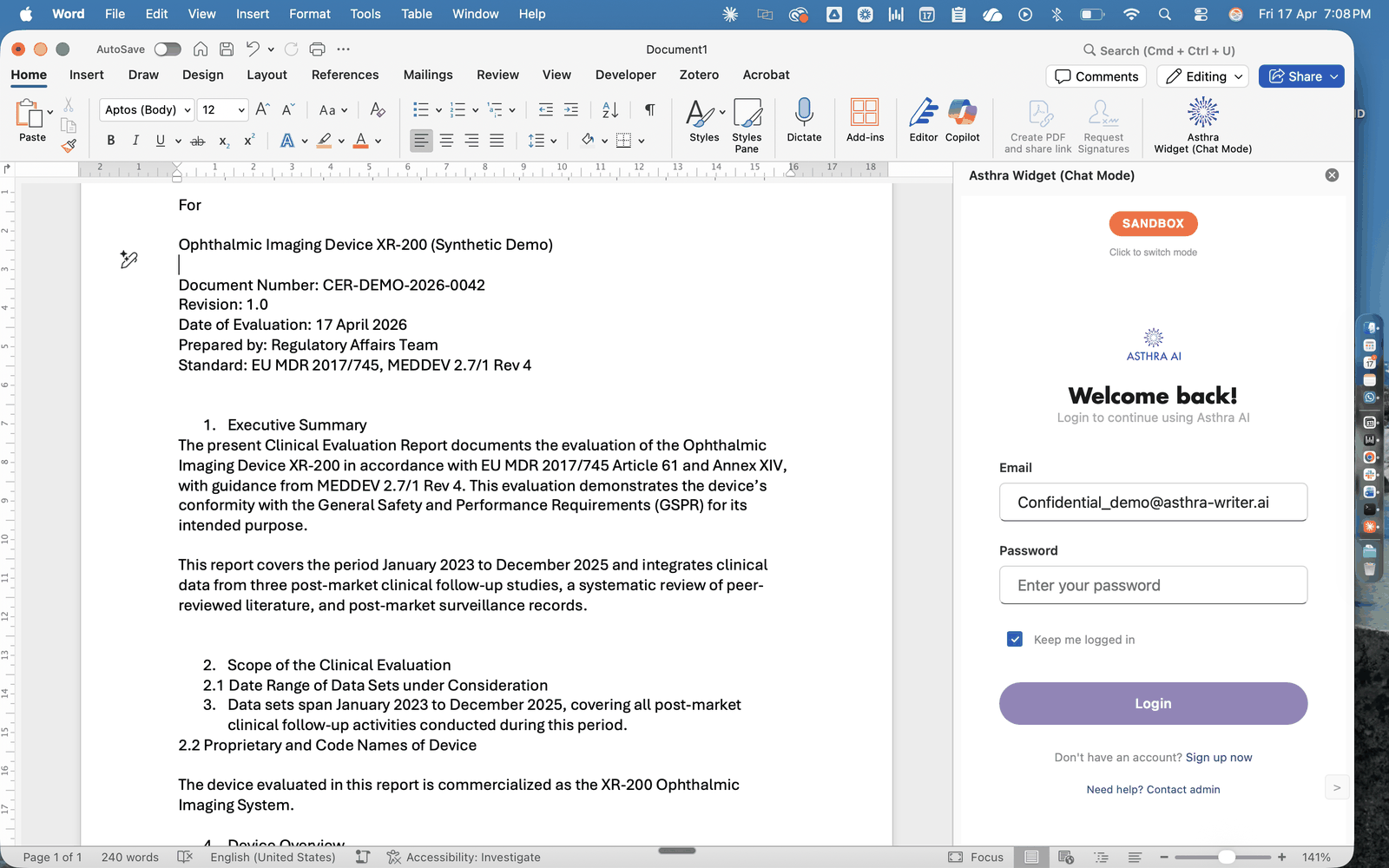
Purpose-designed for regulated writing — agentic retrieval, closed-system drafting, and two-level citations by default.
Asthra AI is a regulatory writing co-pilot for life sciences teams. It generates compliant first drafts of clinical and safety documents — CSRs, PSURs, CERs, and CMC modules — from writer-specified source documents inside Microsoft Word. Every output is grounded in your evidence, cited at the sentence level, and subject to human review.
Built for teams working in regulated life sciences documentation
Regulatory writing is still slow, manual, and repetitive
Writers start from blank templates
Each document begins with a manual review of protocols, trial data, and previous reports. Critical context is scattered across multiple files, requiring hours of synthesis before writing can begin.
Grunt work consumes writing capacity
Copy-paste, rewriting sections across documents, summarizing data tables, and reorganizing information into templates. Seasoned writers spend 60% of their time on mechanical tasks rather than judgment-based work.
Generic AI introduces new risks
General-purpose chatbots hallucinate, lose grounding in source material, and leave reviewers with no way to verify claims. In a regulated submission, unverifiable content is worse than no content.
Timelines compress but effort keeps increasing
Regulatory deadlines tighten while document complexity grows. Teams hire more writers and increase overtime, but cycle times don't improve because the underlying process remains inefficient and manual.
Asthra accelerates drafting — without breaking compliance
Asthra helps life sciences teams generate structured first drafts from source content with writer-defined provenance, on-demand citations, and human-in-the-loop review — so writers can focus on judgment rather than grunt work.
At a glance
What Asthra delivers
Drafts sections faster
Section-specific drafting aligned to your own templates. Choose your source documents, answer a few prompts, and generate a first draft in minutes.
Grounded in your evidence, not model memory
Outputs are generated strictly from writer-specified source documents. No open-internet retrieval. No training-knowledge leakage. Missing data is flagged, never fabricated.
Works inside Word
No new authoring environment. Writers stay in Microsoft Word via the Asthra add-in. Launch, select sources, review the draft inline, edit in place.
Two-level citations, on demand
Every section is cited at the document level and, when you need it, at the sentence level — with file name, page number, and exact text snippet. Supports blind review workflows.
How Asthra drafts: an agent that plans, retrieves, drafts, and hands off
Four steps — every one of them auditable
Plan
The agent produces a retrieval plan: which source files and sections it intends to use for each part of the document. You can review and approve the plan before drafting begins.
Retrieve
Semantic retrieval pulls the right excerpts from your uploaded documents. Nothing from the open internet. Nothing from model training memory. Only your evidence.
Draft
Claude drafts each section against module-specific writing instructions your team validated during onboarding. Missing data is flagged inline, never fabricated.
Hand off
The draft lands in Word with an immutable transaction ledger. Every claim traces back to a source file, page, and passage. Writers edit in place with track changes.
Every tool call, retrieval, and draft is recorded. The ledger stays with the document — independent of Asthra — so audit readiness survives the vendor.
Chat with your draft after it's written
After the first draft lands, Asthra stays in the document with you. Ask the agent why it cited a particular passage, which sources it compared, or whether a claim has supporting evidence. Tell it to rework §4.1, tighten a summary, or swap one source for another.
Every refinement is logged, every citation updates automatically, and every edit goes through the same closed-system retrieval that produced the original draft.
Why did you cite Protocol §8.2 and not the SAP here?
Protocol §8.2 defines the primary endpoint; the SAP derives the analysis method. The endpoint description belongs in §9.3 of the CSR, so I sourced it from the protocol. Want me to add a cross-reference to SAP §3.1 for the analysis population?
Yes, and shorten the paragraph to 80 words.
Illustrative chat. Actual conversations happen inside the Word add-in.
Where teams use Asthra today
Use cases
CSR
Full CSR first draft from trial protocol and TFL. ICH E3 aligned.
Learn more →PSUR / PBRER / DSUR
Aggregate safety reports from historical PSURs, CDS, exposure and safety data.
Learn more →CER
Clinical Evaluation Reports for medical devices — EU MDR aligned.
Learn more →CMC (Module 3)
Consolidate BMRs, CoAs, specifications, and stability data into structured Module 3 content.
Learn more →Designed for regulated environments
Trust, transparency, and compliance
Uses only the sources you provide
Closed to the internet and to the model's own knowledge. Asthra operates strictly within your data perimeter. No external sources contaminate the output.
Flags missing or inconsistent data
When source documents contain gaps or contradictions, Asthra surfaces them explicitly instead of papering over them with plausible-sounding text.
Two levels of traceability
Document-level provenance for every section, plus on-demand sentence-level citations with file, page, and passage. Every generated claim is audit-traceable.
Validation and compliance posture
SOC 2 Type 1 ready. SOC 2 Type 2, ISO 27001, GDPR, and HIPAA certifications in progress. Deploy as managed SaaS or in your own VPC.
Voices from the field
Asthra is in active use with pharma and medical device teams. Named references are available on request.
“Pharmacovigilance teams are under increasing pressure to do more with greater speed and consistency. Asthra applies AI in a thoughtful, compliance-aware manner — automating the heavy lifting while keeping expert oversight central.”
Varun Dua
Founder, PV Analytica — safety and pharmacovigilance advisory
Learn more about AI in regulatory writing
Educational resources and industry insights
Writer-Defined Provenance
How Asthra keeps writers in control of every source decision.
Context Engineering
Why closed-system retrieval beats prompt engineering for regulated writing.
Citations that Hold Up
Two-level citations and what regulatory reviewers actually need.
FAQ
Common questions about hallucination prevention, security, and integration.
See Asthra on your documents.
Request a live demo and discover how Asthra accelerates your regulatory writing workflow without compromising compliance.
Last updated: 16 April 2026