AI agents plan, draft and QC. You review and sign off.
Asthra is an agentic AI platform for regulatory writing. Its agents plan, retrieve, draft, cite and QC. You approve the plan and review the result, in Microsoft Word or the web app. Or start a run, step away, and come back to a finished bundle.
What makes Asthra a platform, not a chatbot.
State-backed authoring means the .docx you see is a render of structured backend state — not the source of truth itself. Four properties make it work in practice — and together they are what the parity-language category (“closed retrieval”, “sentence-level citation”, “audit ledger”) does not on its own deliver. And one more differentiator sits on top: a grounded FDA/ICH review that audits every section against real openFDA precedent.
Word renders. Asthra holds the state.
The Dossier State is Asthra's backend representation of the document — every section, claim, retrieval, approval, edit. Word is one render of it; the audit ledger, the citation graph, and the ability to replay any moment of the run all fall out of having state as the truth.
Walk-away → bundle, not transcript.
Initiate, step away. Asthra works through plan, retrieve, draft, and QC in the background — typically 60–120 minutes. Come back to one audit-ready bundle: the draft with ledger embedded, the citation graph, the QC report, the run metadata. Reopen the .docx and Asthra reloads with the full agent history — not a chat transcript you have to dig through.
Cross-section consistency by the citation graph.
Every claim is bound to its source through the citation graph. Within a single drafting run, that means the same statistical value stays the same across §3, §9, and §13; defined terms and abbreviations drift-free. Cross-document live-dossier propagation — a source change re-flowing into every affected draft — is the next horizon, not what ships today.
Built for the weeks after the first draft.
Every gap and regulatory finding is a tracked to-do, open until something settles it. Resolve flags one at a time or in a pass, regenerate a section with steering, rewrite a highlighted passage. Each change comes back as a diff or a tracked change you accept or reject. See review and refinement →
A grounded FDA reviewer, before the draft leaves your desk.
Regulatory Review audits each section against curated ICH E3 expectations and real approved-product labeling from openFDA, then writes severity-ranked regulator flags inline — anchored to the exact paragraph, recommendations rather than silent edits. Generic AI has no rubric and no precedent; this is the check that turns “sounds regulatory” into “is defensible.” See it in detail below ↓
The five-step loop, on top of state-backed authoring.
Plan → Retrieve → Draft → Review & refine → Hand off. Each step mutates the Dossier State; the .docx in Word re-renders. The agent does steps 01–03; the writer drives step 04 with flag resolution, regeneration and chat; step 05 is the seal-and-deliver.
Asthra plans which sources to use for each section.
Before generating any text, Asthra produces a plan: which source documents it intends to consult for each section of the deliverable. Writers review the plan, swap sources, exclude material out of scope, and approve.
- ✓
Section-by-section retrieval mapping with source-file pinning
- ✓
Edit, swap, or exclude sources before drafting begins
- ✓
Plan is captured in the audit ledger and reproducible
Asthra pulls excerpts from the approved sources.
Asthra indexes the files you upload and pulls the right excerpts via semantic retrieval. No unsupervised internet access, no fallback to pretrained knowledge, no cross-tenant leakage — only the documents you specified. If an external lookup is genuinely needed, Asthra pauses and asks the writer to approve a specific request before fetching anything; the approval and the result are recorded in the audit ledger.
- ✓
Section-aware semantic search, scoped to your document set
- ✓
Tables, figures, and structured data ingested alongside narrative
- ✓
Every retrieval returns a passage, page, and offset — recorded in the ledger
Asthra writes each section from those excerpts, with citations.
Asthra drafts each section against module-specific writing instructions your team validated during onboarding. Every claim is bound to a retrieved passage. Where data is missing, Asthra surfaces an explicit gap flag rather than inventing plausible-sounding text.
Mid-draft, refine through chat: tighten a paragraph, point Asthra at a different document, ask the agent to find recent literature on PubMed, ClinicalTrials.gov, or bioRxiv to support a specific claim. Every external lookup is writer-approved and ledger-logged.
- ✓
Module-specific writing rules (ICH E3, ICH E2C, EU MDR, ICH M4Q) applied per document type
- ✓
Two-level citations: document-level by default, sentence-level on demand
- ✓
Mid-draft literature search across PubMed, ClinicalTrials.gov, bioRxiv — approval-gated
- ✓
Inline gap flags for missing or contradictory source data
Asthra brings the writer in to review and refine the draft.
The agent has produced a first draft, and each section has already been checked against its guidelines and FDA precedent. The writer takes over: every gap, every reviewer note and every regulatory finding is a flag in the text and a row in the Issues list, open until something settles it.
From there you resolve flags one at a time or in a pass, regenerate a section with steering, rewrite a highlighted passage, and ask the draft why it reads the way it does. Every change Asthra makes comes back as a tracked change or a before-and-after diff. Reviewer personas — a named reviewer’s rubric-anchored findings over a section — are on the roadmap.
- ✓
Flags tracked per section: open, resolved, dismissed or superseded, with who settled each one
- ✓
Fix a flag by asking Asthra, writing it yourself, or dismissing it, scoped to the sources you name
- ✓
Regenerate a section or rewrite a selection, then keep or revert the diff
- ○
On the roadmap: reviewer personas — FDA Clinical, CMC, CER Device, CSR Writer QC — for rubric-anchored findings
Most of the work comes after the first draft. Asthra is built for that part.
A first draft gets you to the review. What follows is fixing gaps, reworking sections and tightening prose, usually for longer than the draft took. These are the tools for it, in the Word add-in and the web app.
The draft arrives already reviewed
As each section finishes drafting, it is checked against its regulatory guidelines and against FDA precedent from openFDA. Findings land in the text as regulator flags that say what is wrong and how to fix it. They are advisory: the choice, and the record of it, stay with you.
Resolve a flag where it sits
Every flag is a tracked to-do, listed by section with a count of what is still open. On any flag you can ask Asthra to fix it, write the text yourself, or dismiss it. Before a fix runs you can name the source documents Asthra should look in. The result is a before-and-after diff you accept or discard.
Or clear a whole document
Start a resolve pass over as many sections as you like. Asthra rewrites only the flagged paragraphs and queues each one as a proposal. Nothing is applied until you approve it. You can send a proposal back with more guidance, pause the pass, and resume where it stopped. Dismissed flags are counted apart from the ones that were filled.
Regenerate a section, with steering
When a source changes, such as an amended protocol or a new SAP version, add it to the library and re-draft the sections it touches. Tell Asthra what to steer by, such as “use SAP v2.0; keep the exposure table.” The new version comes back as a before-and-after diff you keep or revert. Open flags in a regenerated section are marked superseded, never resolved: a rewrite is no proof that anyone dealt with the gap.
Rewrite what you highlight
Select a sentence, a paragraph or table rows and say what you want: shorter, plainer, a different emphasis. Asthra returns a replacement for exactly the text you selected, as a before-and-after you approve or reject. It works in Word and in the browser.
Ask the draft anything
Ask about a section or a selected passage, and mention source documents, sections or tables by name. Asthra narrates the steps it takes and keeps that trace attached to the answer, which is the question a reviewer asks: what was this built from? An answer can be applied to the passage it was asked about.
See the source behind a sentence
In the Word add-in, select any text to see the sources behind it: the document, the section, the page and the passage itself. Each drafted sentence also has a “why?” reveal. Where Asthra found nothing, the flag says so carefully: not in the passages it drafted from, though it may still exist elsewhere in the library.
Name a version, compare, restore
Freeze a named version such as “Sent for QC.” Compare any version with the current draft or with another version, and restore a single section or the whole document. A restore is a new revision that cites the old one, so nothing is ever overwritten.
Review it together
Co-edit in real time, with comments anchored to the text and section locks for whoever is working on a part. Access is granted per document and per section, so a reviewer can read everything and edit only the two sections that are theirs. An inbox collects what moved while you were away.
Asthra cannot turn off change tracking
In Word and in the browser, every edit Asthra makes is a tracked change you accept or reject on its own. A writer can switch tracking off for a section. An agent cannot: it is enforced by the pipeline around each write, not asked of the model.
The record says who wrote it
Every revision records its actor as a human, an agent or the system, with the cause of the change and a hash that chains it to the revision before. A sentence you asked for is recorded as the agent’s, on your behalf. An approval is never recorded as authorship.
Nothing outside the edit moves
Text outside the span being fixed is preserved exactly. If the passage has moved or changed since you asked, or identical flags make it uncertain which one you meant, Asthra stops and tells you. It does not guess.
The detail is in two posts: how Asthra resolves the flags it raises and who wrote this sentence.
The draft is delivered with the audit ledger embedded.
The draft lands in Word with an immutable transaction ledger. Every plan change, retrieval, draft step, gap flag, and edit is recorded with a timestamp, actor, and target section. The ledger stays with the document — independent of Asthra — so audit readiness survives the vendor.
- ✓
Append-only ledger embedded in the .docx as a side-channel attachment
- ✓
Each citation resolves to a file, page, and exact passage
- ✓
Track changes capture every writer edit alongside the agent record
What you can do mid-run — without leaving the document.
The five-step loop is what every run does. The capabilities below are composed on top of it — walk-away drafting, an in-draft FDA/ICH regulatory review, review and refinement after the first draft, table and figure analysis in the chat, end-of-run QC and an audit-grade run bundle. Click a chip to jump to it.
Initiate the run. Step away. Come back fully briefed.
Start a CSR or PSUR run, close the laptop, head to a meeting. Asthra works through the plan in the background — retrieving evidence, drafting sections, running the QC pass, packaging the bundle. Return in 1–2 hours to a first draft with the bibliography and quality report in place.
The draft is a starting point, not the finish line. Regulatory work needs the writer's judgement — and the Asthra workspace is where that judgement gets applied. Open the document and it loads everything the agent did while you were gone: the full chat history, every retrieval, every tool call, every gap flag, every QC finding. Continue the conversation as if no time had passed. Resolve the flags in §9.4, regenerate a section with steering, rewrite a highlighted paragraph, and ask the agent why a passage reads the way it does. See everything you can do after the first draft. Walk-away delivers a fast first draft; the workspace is where you take it to submission-ready.
- ✓
Background execution with progress visible per stage
- ✓
Approval gates surface as notifications when the agent needs your input
- ✓
Resumable — interrupt the run mid-stage, resume from the last checkpoint
- ✓
Bibliography and QC report in place when you return
- ✓
Native continuity — Asthra loads the full agent history when you reopen the document; nothing is lost between the run and your review
✓ What it is
A background-execution mode that produces a first draft plus bibliography and a QC report in 1–2 hours, with the full agent history available when you return.
× What it is not
Autonomous AI submission. The draft is a starting point for the writer's review, not the finished deliverable. Regulatory work still needs the writer's judgement.
An FDA/ICH reviewer's eye, inside the draft.
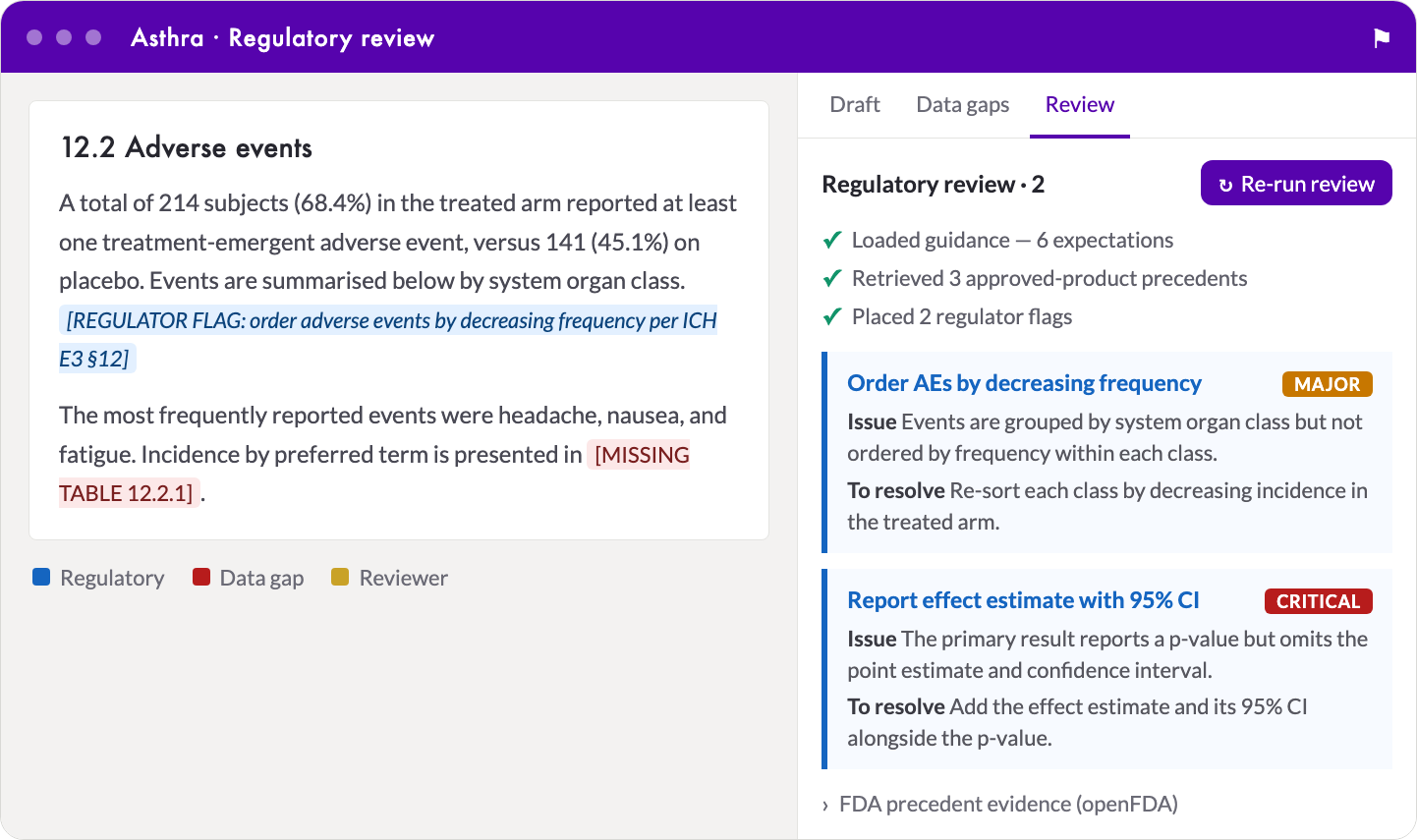
Run a section-by-section regulatory audit right where you write. Regulatory Review checks each drafted section against curated ICH E3 expectations, grounds its judgement in real approved-product labeling pulled live from openFDA, and writes specific, severity-ranked regulator flags inline — at the exact spot they apply. It recommends; it never rewrites your words.
- ✓
Each section audited against curated ICH E3 expectations, every one carrying its own severity — critical, major, or minor
- ✓
Grounded in real approved-label precedent from openFDA — used only to judge what regulators expect to see, never to borrow another product's numbers
- ✓
Findings placed inline as
[REGULATOR FLAG]markers, anchored to the paragraph they apply to — recommendations, not silent edits - ✓
Idempotent, fail-soft, and persistent — re-run anytime; it degrades gracefully and never corrupts the draft
✓ What it is
A deterministic audit pass — curated guidance in, real FDA precedent alongside, structured recommendations out, planted in the document where they can be checked and re-checked.
× What it is not
A rewrite, or a chatbot role-playing an inspector. It advises with an anchor; the writer keeps the words. Configurable reviewer-persona scorecards are a separate capability, on the roadmap.
Read more: Regulatory Review, under the hood → · CSR automation →
Analyse huge tables in the chat — with code you can audit.
Adverse-event line listings, sales and exposure data, lab parameter shifts — the data behind a CSR or PSUR runs into thousands of rows. Most writers spend hours filtering, pivoting, and reformatting in Excel before they can write a sentence about it. Asthra's data analysis agent handles that step inside the chat: ask for a frequency table by system organ class, a cumulative incidence over time, a sales-exposure chart for the reporting period — the agent does the analysis and returns the table or figure ready to insert into the draft.
The analysis is run as deterministic Python code, not LLM-fabricated arithmetic. The LLM proposes the analysis plan; Python executes it against your line listing. Every step — the data slice, the filter, the aggregation, the chart spec — is logged in the audit trail with the exact code that produced the output. If a reviewer asks “how was this Grade 3 AE table generated,” the answer is a Python script you can re-run.
- ✓
Deterministic Python execution against your data — no LLM-fabricated numbers
- ✓
Use cases: AE line listings, lab shifts, exposure / sales data, demographics
- ✓
Outputs include aggregated tables and figures (bar charts, line plots, forest plots) ready to drop into the draft
- ✓
Every analysis step audit-logged with the exact code and inputs — fully reproducible
✓ What it is
Agent-driven analysis of line listings, sales data, and lab parameter files using deterministic Python — every step audit-logged with the exact code that produced the output.
× What it is not
An LLM doing arithmetic. And not a substitute for the statistician on pre-specified primary or secondary analyses — those still come from the SAP.
Every run ships a QC report — and an audit-grade bundle.
When the agent finishes drafting, Asthra runs a structured quality pass: cross-reference integrity, statistical-claim source binding, defined-term ordering, citation density, and gap detection. The result is a structured QC report packaged alongside the draft — one place to triage every flag before review.
Every run produces an audit-ready package: the draft itself, the full trail of how it was produced, the QC report, and the reproducibility metadata for the run. The package is portable, survives the vendor, and is the deliverable you can hand to an inspector.
- ✓
QC checks span integrity, sourcing, density, gaps — schema-typed findings
- ✓
Bundle is reproducible by replay from the event log
- ✓
Traceability survives the vendor — the .docx and JSON are yours to keep
✓ What it is
A deterministic quality pass over five structural checks (cross-reference integrity, source binding, defined-term ordering, citation density, gap detection), packaged with the draft as a portable run bundle.
× What it is not
A copy edit or a prose-quality review. QC checks structure; the writer handles substance in review — reviewer personas, on the roadmap, will assist that pass.
Built for regulated writing — every layer earns its keep.
Foundation models alone don't ship in regulated environments. Asthra adds the writer workspace, the agent orchestration layer, the closed-system retrieval, the citation graph, the end-of-run QC, and the audit ledger that turn a capable model into an audit-ready writing agent.
See Asthra
on your documents.
30-day pilot. We benchmark Asthra's output against your existing process — and show you the writer-hours saved, line for line.